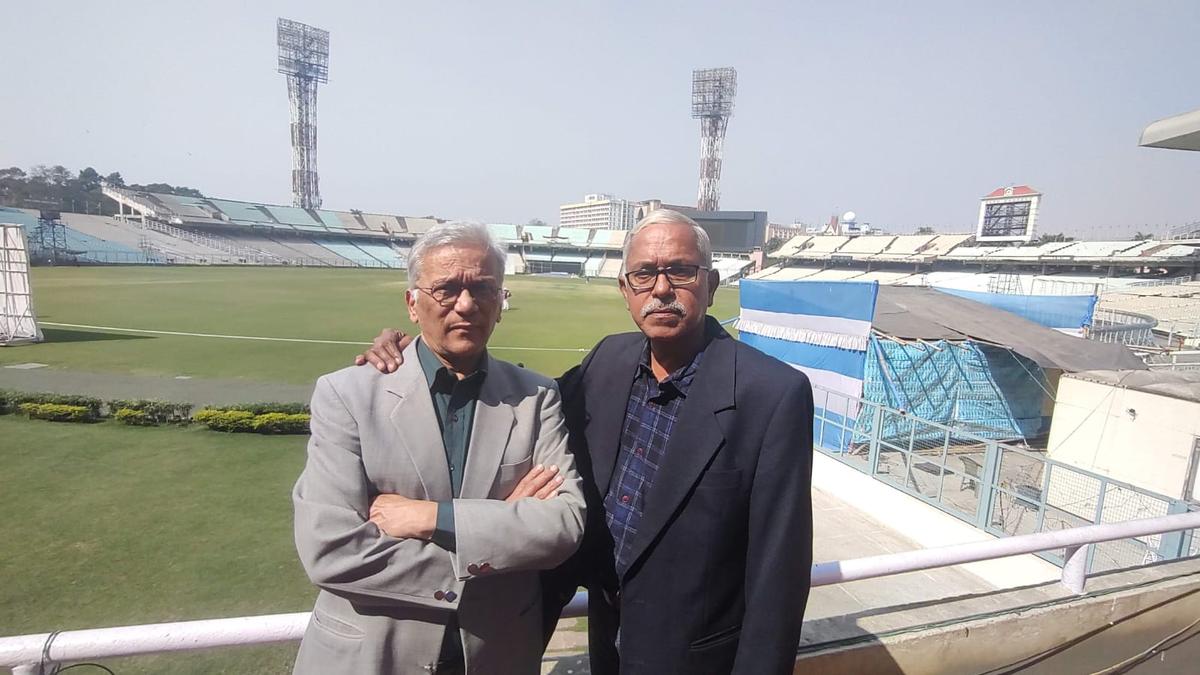
Cricket chose the best venue in India to gift fans the greatest Test played on their soil. Eden Gardens, with its history of unforgettable contests, witnessed a spectacle that comes perhaps once in a lifetime: a five-day match that ended in the last session on the final day. To be in the stadium for that incredible finish was a privilege.
Eden has always held a special place in my cricket travels. From writing about Mohammed Azharuddin’s debut in 1984 to two fascinating contests in the 1993 Hero Cup, the City of Joy has grown on me. The Calcuttans’ unwavering passion for the game and their support for the team give the venue iconic status. Of course, there have been sporadic and forgettable episodes of the crowd interrupting matches, but I would call them uncharacteristic.
Do you remember the 1997 Women’s World Cup final between Australia and New Zealand? There was not a vacant seat at Eden. Such is the passion for the game. The men’s World Cup in 1987 was no different, when a packed house cheered Australia as it tamed England.
ALSO READ | In Kolkata, we sowed the seeds for long-term dominance: Ganguly recalls historic 2001 Eden Test
What was it like on March 15, 2001, when the city came to a standstill? The maidans around Eden celebrated the amazing victory long after the team had left the venue for the airport, en route to Chennai for the following Test.
Honestly, few Indian reporters expected the team to spring a surprise on the mighty Australians. India had only two players, Sachin Tendulkar and V.P. Raju, who could boast more than a decade of international experience. It was essentially a raw combination under a new coach, John Wright. The match, however, produced new heroes for Indian cricket followers. A new world order was established in Test cricket, and Eden played a gigantic role. India emerged as a prominent influencer and a formidable challenger to Australia’s dominance.
Eden was a cauldron on all five days. My morning walk to the stadium from the Kwality Inn offered a pleasant insight into the sporting psyche of the Calcuttans. Moving past groups of fans seeking match tickets, I would slow my pace and try to overhear their conversations. The animated discussions reflected their knowledge and passion as they dissected the previous day’s play and what lay ahead. Cricket seemed to occupy their minds 24 hours a day. They displayed insight that could have matched those in the broadcasters’ box.
I loved the ambience outside Eden Gardens. The mounted police, raising clouds of dust every time they chased some of the rowdier elements, were quite unpopular. But the fans took their roughness in stride. The craze for cricket on the maidans flowed from their love of life and their loyalty to the game, which found expression in the evening neighbourhood addas. I could feel it during my post-lunch observation when I sat in the stand below the Press Box, located in the upper tier of the Club House.
ALSO READ | John Wright on Eden 2001 epic: I’ve never been involved in a match so extraordinary
For a fan to be convinced at the end of the fourth day that India stood a good chance to strangle Australia on a pitch that could deteriorate might have seemed laughable. But these fans had the last laugh. India won a contest that belonged to Australia until tea on the final day.
The atmosphere at Eden was magical. The gods of cricket had come together to conceive a plot that brought happiness to 100,000 fans inside the stadium and another 100,000 outside. Their collective roar must have been heard in Melbourne as Harbhajan Singh trapped Glenn McGrath leg before. The walk back to the hotel after finishing work at the venue took unduly long as I made my way past the boisterous celebrations. But I loved it, having become part of Eden’s history.
-Vijay Lokapally
V.V.S. Laxman’s 281 against Australia at the Eden Gardens will remain imprinted in my mind for a long time, even though I have been privileged to watch Sachin Tendulkar, Virender Sehwag, Mohammed Azharuddin, Sourav Ganguly, Rahul Dravid and several others play outstanding innings. For it was an effort that changed the course of Indian cricket like few others.
I had not started my career as a photojournalist when Kapil Dev breathed life into India’s Prudential Cup campaign with his 175 not out against Zimbabwe in Tunbridge Wells in 1983, but I was fortunate to witness Laxman’s 281. I would say it rejuvenated Indian cricket at a time when the team was emerging from the darkness that had enveloped it barely a year earlier.
Back in the days when digital cameras were not yet the norm, I used to indent about 60 rolls of colour film for each Test match. Since the first Test in Mumbai had ended inside three days, I believed my decision not to replenish my stock ahead of the second Test was justified when India was 128 for eight on the second day in reply to Australia’s 445.
The first signs of defiance came when Laxman shared a 42-run last-wicket partnership with Venkatesh Prasad. Even then India had conceded a 274-run first-innings lead and the writing was on the wall – or so it seemed. But a smart decision to send Laxman in at No. 3 in the second innings worked like magic for India.
The manner in which he took on Shane Warne, the great leg-spinner, with his decisive footwork was a treat to watch through my viewfinder. It was hard not to feel disappointed when he fell for 281, caught at gully off Glenn McGrath on the fifth morning, when the whole nation was willing him to become the first Indian to score 300 in a Test match.
Two things prompted me to add more rolls of film to my stock after the third day’s play. Following on, India bucked the trend of a cluster of wickets falling after the tea break. Sourav Ganguly was the only batsman to be dismissed, and that too after a battling 117-run stand with Laxman. Later, he told me there was nothing left in the pitch for the Australian bowlers.
Back in the pavilion, V.V.S. Laxman and Rahul Dravid seen engaged in conversation after a tiring, marathon stay at the wicket. | Photo Credit: V.V. Krishnan
I readied myself for the Test to end on the fourth day, believing it was only a matter of Australia securing an early breakthrough. I had not imagined Laxman and Dravid batting through the entire fourth day without being separated. As they wore down the visiting bowlers and then began to dominate them, it was both a treat and a challenge to capture images of their defining partnership.
As they walked in after a long day in the middle, weary from their efforts, I asked if they would pose for a photograph just outside the Indian dressing room. They readily agreed and sat in cane chairs. They broke into smiles as Dravid put his arm around Laxman’s shoulder. It is a frame I still cherish, even a quarter of a century later.
I told myself to make another trip to get more rolls of film for the final day. Looking back, those visits to the friendly photo studio each evening were well worth the trouble. With Harbhajan Singh picking up six wickets and Tendulkar claiming three crucial scalps, India had pulled off a victory that would have been inconceivable 48 hours earlier.
Yet, with due respect to Dravid, Harbhajan and Tendulkar, Laxman’s monumental 281 remains the standout memory from that Test match. Of course, no one needs reminding that cricket is a team sport, but his innings was like that of a virtuoso performer on stage rising above the symphony produced by an orchestra.
-V.V. Krishnan
Published on Mar 15, 2026